
How many restrooms does a race need?
Start with the crowd, not the course map. A finish line holding 500 spectators for two hours needs more units than a rolling aid station that sees runners for ten minutes. OSHA 1926.51(c) governs worksite crews, but race organizers in Palmdale use it as a rough benchmark anyway: one toilet for every 20 people works as a starting ratio, then you adjust for how long people stand around versus pass through. Start and finish areas need the heaviest coverage because that is where people cluster before and after. Aid stations at mile 3, mile 6 and mile 9 need fewer units each, but they still need at least one, and an ADA accessible porta potty at every cluster per ADA Standards 213.2, which requires 5 percent of clustered units be accessible, never fewer than one. A standard porta potty rental runs 100 to 150 dollars a day, and a weekend rate for a two-day race weekend lands around 250 dollars per unit. For bigger fields, a restroom trailer rental at the finish line handles a surge better than a row of single units, especially if you want handwashing built in. Check our how many porta potties do I need guide before you finalize a headcount, and price the whole event with our porta potty rental cost page.
Where do units go on a race course?
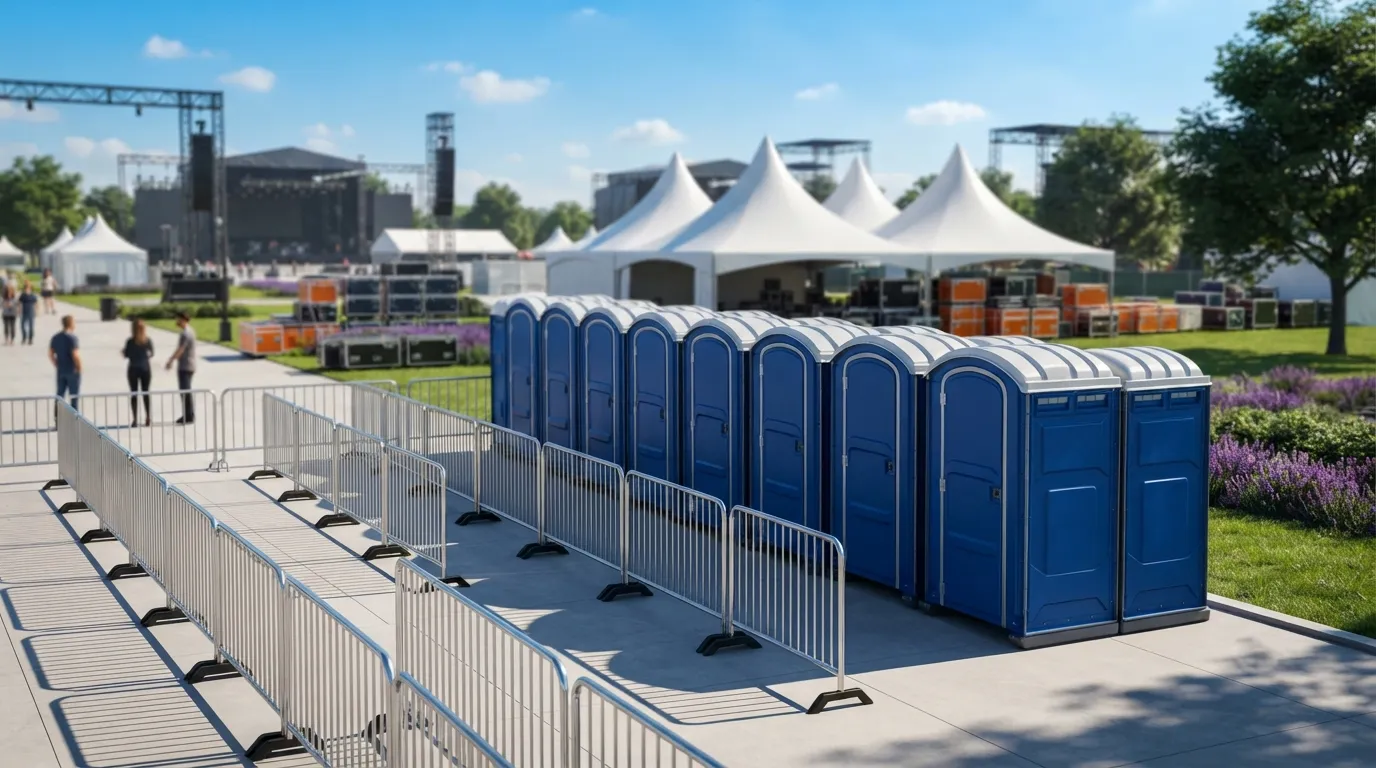
Placement follows the runners, not convenience for the truck. Units belong at the start corral, every aid station, and the finish chute, spaced so nobody has to leave the course to find one. A porta potty placement guide matters more for a point-to-point race than a loop course, because you cannot double back to fix a bad spot on race morning. Ground needs to be level and firm, since ADA Standards 302.1 requires stable, slip resistant surfaces for the accessible units in the group. If the race route runs near Desert View Highlands, 3.9 miles west of central Palmdale, or loops toward Quartz Hill, 9.7 miles northwest, we scout the actual road shoulders before delivery day, not from a map. Standard units run about 44 by 48 inches on the ground and stand 92 inches tall, so a narrow shoulder or a bike lane closure can still fit a row of them if spacing is planned. Some races also run a light tower or two near a predawn start line, and if your event needs a temporary power pole for timing equipment or a PA system, knowing how to brace a temporary power pole matters before setup: guy it at two points minimum, anchor the base plate, and check the guy lines again the morning of the race, since Palmdale wind can hit hard along unshielded stretches near Sun Village, 10.9 miles east. A wobbling pole near a finish line timing mat is a hazard nobody wants on race morning. For crowd lanes at the start and finish, a crowd control barrier rental keeps runners funneled the right direction and keeps spectators off the course.
What does a race weekend restroom package cost?
Race weekends usually mean Saturday setup and Sunday teardown, so pricing runs on a weekend basis rather than a single day. Here is how the pieces stack up:
| item | day rate | weekend rate |
|---|---|---|
| standard unit | 100 to 150 | 125 to 400 |
| ADA unit | 200 to 400 | 199 to 300 |
| handwashing station | see below | see below |
| delivery fee | 100 to 500 | 125 to 540 |
A handwashing station rental pairs with every restroom cluster along the course, and 29 CFR 1910.141(d)(2) requires soap and towels or a hand dryer at any station, not sanitizer alone, so we stock ours accordingly. Races with a post-run pasta feed or a beer garden sometimes add a portable sink rental near the food tent. Multi-day festival races that stretch into a full weekend event should check our temporary fence rental options too, since a fenced perimeter around the finish line festival area keeps foot traffic organized. For an exact quote tied to your runner count and course layout, the request a quote form gets you a number fast, and our porta potty rental per day page breaks down single-day pricing if your race is a one-day event with no weekend setup.
How far in advance should we book restrooms for a race?
Book as soon as your course map and expected runner count are set, ideally six to eight weeks out. Race weekends compete with other Palmdale events for the same trucks and units, so early booking secures your preferred delivery window and avoids last-minute substitutions.
Do we need accessible units at every aid station?
Yes, where units are clustered. ADA Standards 213.2 requires at least 5 percent of any cluster to be accessible, and never fewer than one unit, so even a small three-unit aid station needs one accessible model.
Can units handle a course that spans multiple towns?
Yes, drive time is the main factor. A course looping toward Littlerock, 10.9 miles southeast, or Acton, 12.0 miles southwest, just needs delivery routes planned early so servicing during a multi-hour race stays on schedule.
What size trailer works for a large marathon finish line?
An 8 stall restroom trailer handles high-volume finish lines best. Smaller races or aid stations do fine with a 2 stall restroom trailer or standard single units instead.
Do you service units during a multi-hour race?
Yes, for longer events we schedule a mid-race service pass. ANSI/PSAI Z4.3 sets a baseline of one weekly service visit for lighter use, but race-day crowds need a same-day check between morning start and afternoon finish.
Next step
Get a delivery date
Tell us the address, the dates and the headcount. We size the order and confirm the route.